Flagship article
AI Risk Is No Longer A Technology Problem. It Is A Governance Problem.
The first wave of AI adoption was framed as a technology question: which model, which vendor, which data, which interface, which productivity use case. That framing was useful at the beginning. It gave teams a way to experiment, compare tools, and understand the immediate risks around privacy, accuracy, security, and model behavior.
But it is no longer enough. Once AI starts influencing decisions, workflows, customer interactions, controls, analysis, reporting, code, operations, and management judgment, the question changes. The real issue becomes governance: who owns the risk, who approves the use case, who monitors performance, who challenges the output, who knows when to stop, and who is accountable when the system behaves differently than expected.
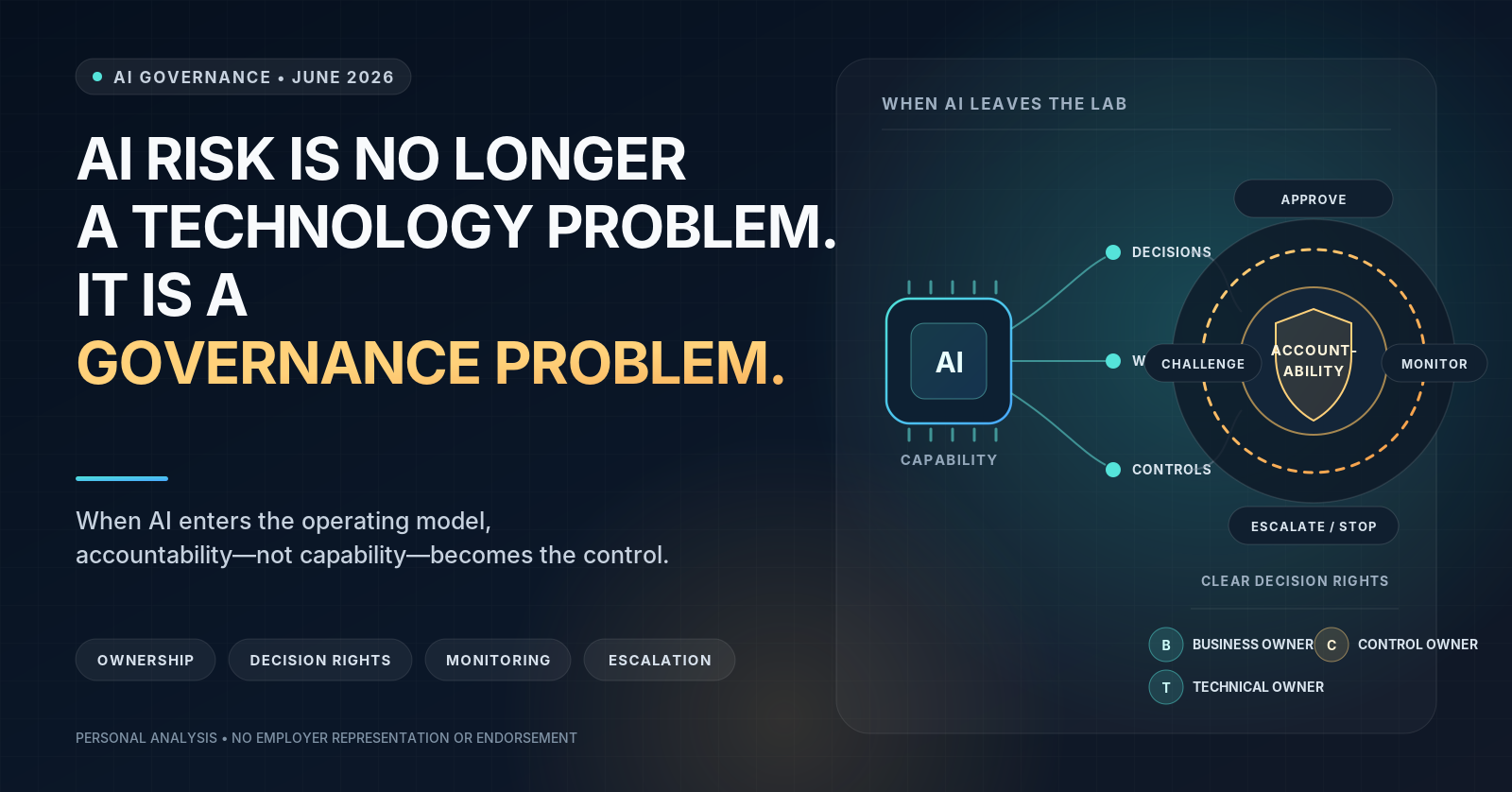
AI risk becomes serious when it leaves the innovation lab and enters the operating model.
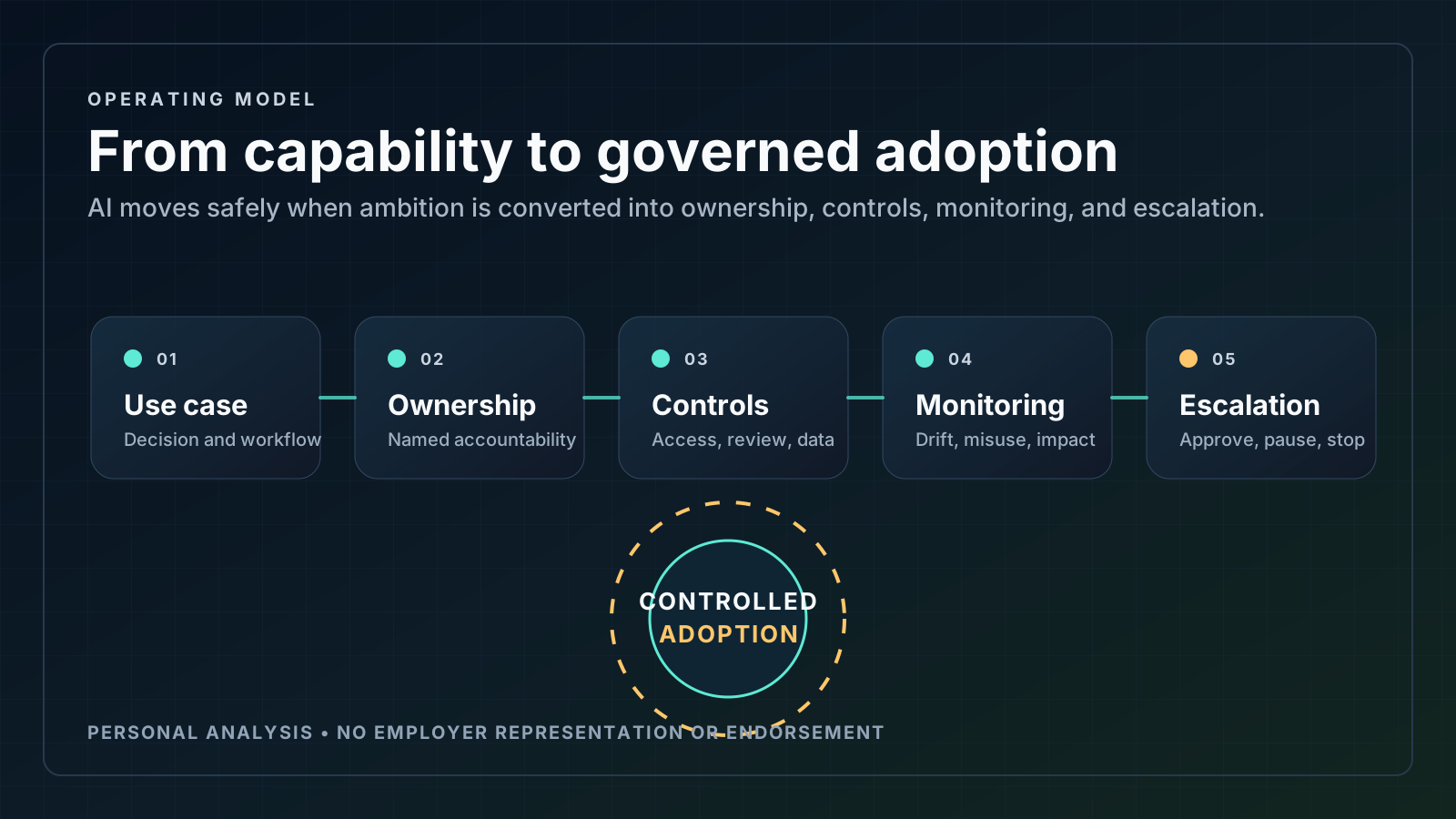
The Trap: Treating AI As A Tool Instead Of A Decision System
Many AI conversations begin with capability. Can it summarize? Can it forecast? Can it generate code? Can it classify documents? Can it automate a workflow? Those questions matter, but capability is not the same as control. A powerful tool can create weak outcomes if it is inserted into a process without ownership, context, escalation, or evidence.
In risk terms, the issue is not whether AI is impressive. The issue is whether the organization understands the decision pathway it is changing. If a model supports analysis, what human review remains? If it drafts communications, who approves the final message? If it ranks risks, what happens to the items it deprioritizes? If it accelerates development, who checks security and resilience? If it supports forecasting, who understands the assumptions?
The more AI becomes embedded in daily work, the less useful it is to treat it as a standalone technology. It becomes part of the control environment.
Good AI Governance Starts Before Deployment
A mature AI operating model should not wait for incidents to define its standards. The key questions should be answered before a use case goes live.
- What business decision or workflow does this AI use case affect?
- Who is the accountable owner?
- What data does it use, and what data must it never use?
- What level of human review is required?
- What is the failure mode?
- How will performance, drift, misuse, and unintended consequences be monitored?
- What triggers escalation, suspension, redesign, or retirement?
These are not bureaucratic questions. They are speed questions. Organizations move faster when they know where the guardrails are. Ambiguity slows adoption because every team has to renegotiate the same risk boundaries in a different language.
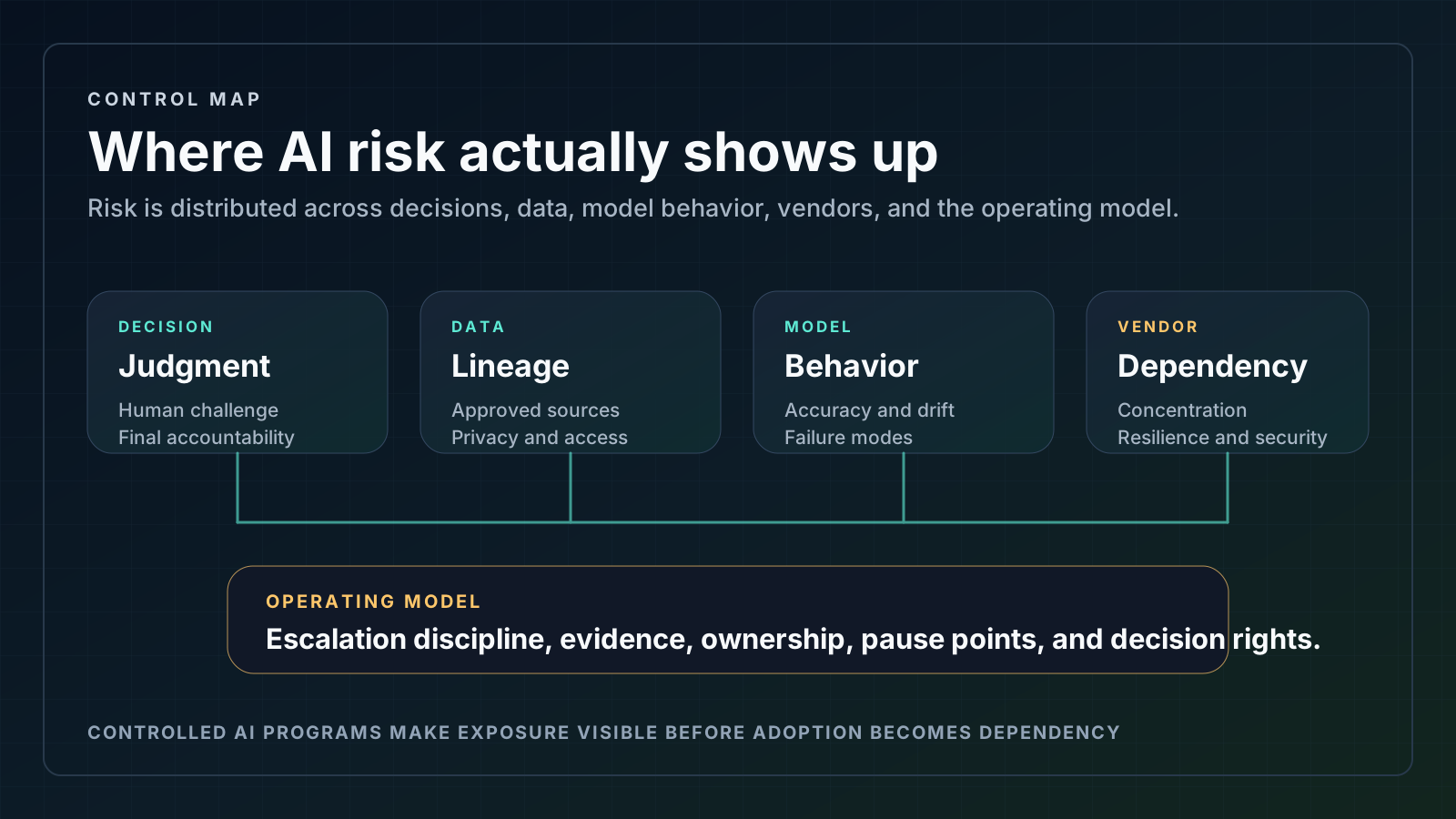
Ownership Is The Center Of The Model
The weakest AI governance models treat ownership as a shared feeling. Everyone is interested, but no one is accountable. Technology teams understand the systems. Business teams understand the process. Legal and compliance teams understand obligations. Risk teams understand controls and consequence. Senior leaders understand strategic appetite. But AI risk does not become governed until those roles are converted into decision rights.
A practical model defines ownership at three levels: the business owner who is accountable for the use case, the technical owner who is accountable for system behavior, and the control owner who is accountable for monitoring, challenge, and escalation. Without that structure, AI can scale faster than accountability.
The Risk Is Not Only Model Error
Accuracy matters, but it is only one category of exposure. AI risk also includes overreliance, automation bias, weak explainability, poor data lineage, privacy leakage, intellectual property concerns, vendor concentration, cybersecurity exposure, control bypass, unapproved shadow usage, reputational harm, and operational fragility.
The most dangerous failure may not be a spectacular model hallucination. It may be a quiet change in behavior: people stop asking second-order questions, controls become informal, exceptions become normal, and teams confuse speed with resilience.
The governance standard should not be "the model usually works." The standard should be "the operating model remains controlled when the model is wrong, incomplete, misused, unavailable, or misunderstood."
AI Risk Needs Escalation Discipline
Escalation is where governance becomes real. If teams do not know what to escalate, when to escalate, and who can make the decision, then the framework is mostly decorative.
Escalation triggers should be concrete: material accuracy degradation, unexpected output patterns, unauthorized data exposure, abnormal user behavior, vendor incidents, unresolved control gaps, regulatory concerns, customer impact, operational dependency growth, or use beyond the approved scope. The point is not to create fear. The point is to make weak signals visible before they become expensive.
Risk Leaders Should Ask Better Questions
The risk function should not position itself as the department of "no." That approach fails because AI is already becoming part of how work gets done. The better posture is disciplined enablement: help the organization move with speed, but insist that speed has structure.
Better questions create better adoption:
- Where does AI change a decision, not just a task?
- Which controls become more important because the process is faster?
- What evidence would prove that the use case is still operating within appetite?
- What would make us pause or redesign this use case?
- How do we prevent local experiments from becoming unmanaged enterprise dependencies?
The Leadership Standard
AI governance is ultimately a leadership test. It requires ambition without naivety, control without paralysis, and enough operational discipline to make innovation durable. The best leaders will not be the ones who simply adopt AI the fastest. They will be the ones who understand what AI changes about accountability.
The organizations that succeed will treat AI risk as part of enterprise governance, not as a side conversation for technology teams. They will define ownership early, establish clear standards, monitor real outcomes, and keep human judgment where judgment matters.
AI can improve speed. Governance determines whether that speed compounds into advantage or exposure.